

When I look at a provider delivering high intensity supports, I ask one question first. Who is on tonight's roster for this participant, and where is the evidence that each of them is trained for this participant's plan as it stands today?
A training log answers a different question. It tells me who completed a course and when. The Practice Standards for high intensity daily personal activities ask for something more specific: training tied to each participant, delivered by the right person, and kept current as plans and rosters change.
This is how I would set up the system that holds that evidence, and what it has to be able to show.
What counts as a high intensity daily personal activity
The NDIS Commission lists eight high intensity daily personal activities:
- complex bowel care
- enteral feeding and management
- severe dysphagia management
- tracheostomy management
- urinary catheter management
- ventilator management
- subcutaneous injections
- complex wound management.
Each one has its own outcome and quality indicators in Module 1 of the Practice Standards, and providers registered for registration group 104 are assessed against Module 1 and the core module, including medication management. A registered provider can only deliver the high intensity supports set out in its certificate of registration, so the first record to check is that certificate against what your teams deliver.
The Commission also publishes guidance for epilepsy and seizure support alongside the eight. If your participants live with epilepsy, treat that guidance as part of the same system.
What the skills descriptors ask you to show
The Commission's high intensity daily personal activities module links to the high intensity support skills descriptors. They describe the skills and knowledge your workers should have when these supports are delivered by a competent support worker who is not a qualified health or allied health practitioner. The current version took effect on 1 February 2023.
They matter for audit. The Commission says auditors use the descriptors to decide whether a provider has met the high intensity standards, and that providers should be able to demonstrate at their three yearly audit, their mid term audit, or whenever compliance requires it, that workers have the necessary skills and training.
Every descriptor carries the same sentence about records: providers are responsible for ensuring workers have current skills and knowledge, "and that the training of workers is documented and regularly audited."
The core module sets the frame around it. It expects "a system to identify, plan, facilitate, record and evaluate the effectiveness of training and education for workers", with the skills required for each position documented. For a high intensity team, that system is where this whole article lives.
Competency belongs to a participant
Read the training indicator for any of the eight supports and the pattern is the same. Workers supporting a participant have completed training "relating specifically to each participant's needs", the type of support involved, and the matching skills descriptor.
That wording changes what a record has to hold. A worker trained in enteral feeding for one participant has met the indicator for that participant's needs and regime. When they start supporting a second participant with a different regime, the record needs training for that participant too.
So I set up every high intensity record as a pair: this worker, for this participant. A worker can appear in several pairs, and each pair carries its own evidence.
Laura put it plainly when we talked about how a provider shows its skills mix:
"If that person is working with high intensity participants, you want to make sure that you're capturing the skills that they've got to be working within that scope. You want to show what training they've had."
- Laura Saul, NDIS compliance lead
Who is allowed to train your workers

For most of the eight supports, training is delivered by an appropriately qualified health practitioner, or by a person who meets the expectations of that skills descriptor. That second route lets an experienced, assessed worker train others.
Two exceptions to build into your system:
- Severe dysphagia management. Training must only be delivered by an appropriately qualified health practitioner with expertise in severe dysphagia management.
- Epilepsy and seizure support. The descriptor names a health practitioner with expertise in epilepsy management, or a person who meets the requirements of the descriptor.
Where a support worker trains others, the Commission's guidance says a provider may need to show competency evidence, assessment evidence and data collection evidence that the person is competent to train. So the trainer needs a record of their own, and every training entry should name who delivered it and on what basis.
Subcutaneous injections carry one more document. The indicators expect written or phone orders from the health practitioner prescribing the medication that trained workers may give by injection. I keep that order with the participant's plan, where the worker can see it.
The three moments to reassess
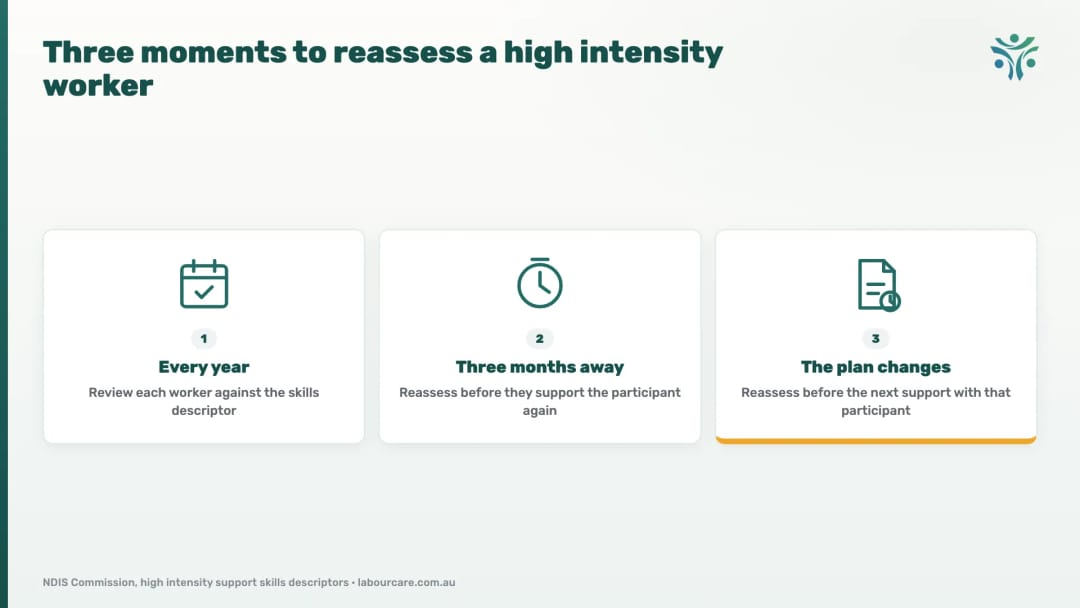
The descriptors recommend reviewing each worker's competency at three points:
- Every year. An annual review confirms the worker still has the skills and knowledge in the descriptor.
- After three months away from the support. Where a worker has not delivered the support for more than three months, reassess them before they support the participant again.
- When the plan changes. Where a participant's support needs have changed or they have an updated support plan, reassess the worker before they support that participant.
These are recommendations, and the Commission says the timeframe may vary with the support and the worker's experience. Whatever timeframe you set, write it into your policy, and make sure your system follows the policy you wrote.
The first moment is a date. The second and third are events, and they happen in other places: the roster knows when a worker last supported a participant, and the support plan carries its own version date. A system that tracks competency has to see both.
Where a training spreadsheet runs out
I see most providers start with a spreadsheet of workers, courses and completion dates. For a small team with one person keeping it current, that can hold the annual review. The trouble starts with the other two moments.
A spreadsheet cannot see the roster, so it cannot tell you that a worker has gone four months without supporting a participant on a ventilator. It cannot see the support plan, so it cannot tell you that the plan was updated last Tuesday and three workers on this week's roster were trained against the old one. Someone has to notice, every time, and then update the sheet by hand.
That is why the system I recommend links three records: the roster, the support plan and the training register. Many rostering platforms can now hold worker qualifications and block a shift when one has lapsed. Set that up so a worker whose high intensity competency for this participant is due for reassessment cannot be rostered to them until it is done. That control does the noticing for you.
Our article on choosing compliance software for a SIL service covers when spreadsheets stop working generally, and what to ask in a software demo.
What a high intensity competency register holds
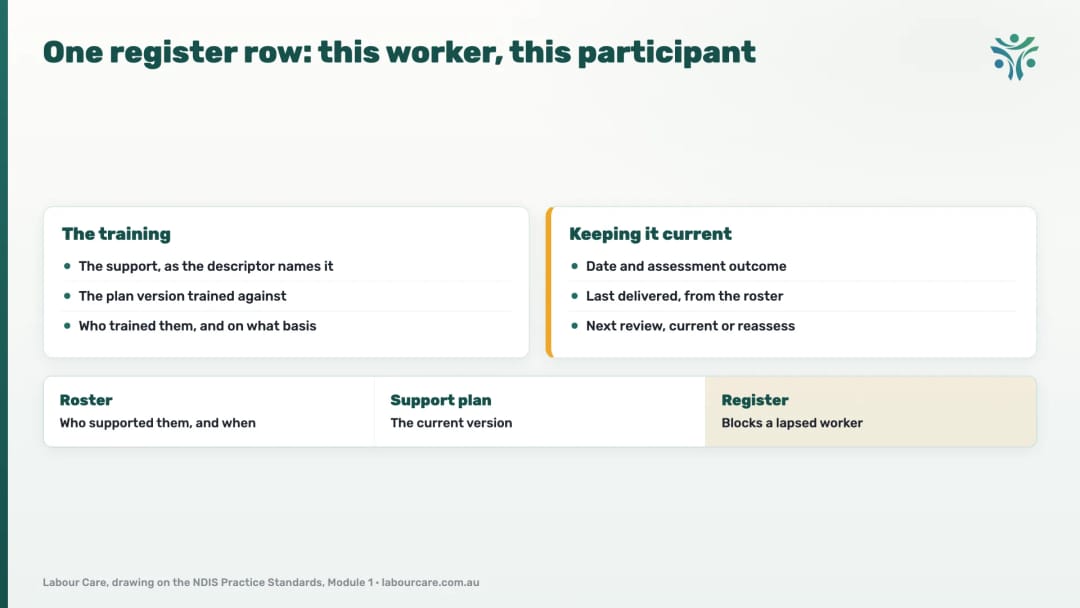
For each worker and participant pair, I want these fields in one place:
- The support, named as the skills descriptor names it.
- The plan version the worker was trained against, with its date.
- Who trained them, their qualification or the record showing they meet the descriptor.
- The training date and the assessment outcome, with the evidence attached.
- The last time the worker delivered this support to this participant, drawn from the roster.
- The next review date, and a status that reads current or reassess.
Keep the participant's plan beside it. The Module 1 indicators expect each participant to be involved in developing their plan, their health status to be reviewed regularly by an appropriately qualified health practitioner with their consent, and the plan to set out how risks, incidents and emergencies are managed, including escalation. They also expect policies and procedures for each support, including a training plan for workers.
Pull those together and you can answer the auditor's question for any participant in a few minutes. Our guide to record keeping requirements covers how long those records must be kept.
What an auditor can ask to see
The descriptors are written for auditors as much as for providers. In practice, I would expect an auditor to choose a participant who receives a high intensity support and work outwards from them. Their plan. The workers on their roster. The training evidence for each of those workers, for this participant, against the current plan. Who delivered that training, and on what basis.
Then the auditor will want to see the system working at the onsite stage, which includes interviewing staff. A worker who can tell the auditor how this participant's plan changed, and when they were reassessed, is evidence your register is being used. Our SIL audit checklist covers the rest of the evidence an auditor asks for, and much of it applies to high intensity teams in shared homes.
Worker screening and induction sit underneath all of this. Our worker screening renewal guide covers the clearance every worker needs before any of it applies.
Where I would start
If you deliver high intensity supports today, this is the order I would work in.
First, list every participant receiving a high intensity support, which of the eight supports, and the current version of each plan. Check each support appears on your certificate of registration.
Next, take the last three months of rosters and list every worker who supported each of those participants. That gives you your worker and participant pairs.
Then match each pair to training evidence for that participant, against the current plan, with the trainer named. Every pair without it is a gap, and the gaps on your most complex supports come first.
Finally, set the three reassessment moments into your system, so your roster flags the next gap the day it opens.
Our Health Check reviews your documents, registers and records against the Practice Standards you are registered for, and rates every finding purple, red, yellow or green, so you know what to fix first and by when. Our audit preparation page sets out how we work with you after that.
Bring us what you have got
Whatever you have got, bring it to us, and we will help you fix it. There is always someone on our team to pick up the phone.
Book a free initial consultation, or get in contact to see how we can fit your budget.
Share this article: