
The first thing an auditor asks a SIL provider for is evidence. A certification audit opens with a desktop audit, where the auditor asks for information and evidence, usually off site. The onsite audit follows, and the Commission says it should happen within three months of the desktop stage being completed. Onsite, the auditor looks at how you are implementing your policies and procedures: they view records, interview staff and participants, and watch supports being delivered.
So when a SIL provider comes to us with an audit on the horizon, my first question is a simple one. If the auditor asked for it tomorrow, could you find it?
This is the checklist I work through with them. It covers the areas of evidence the Commission describes auditors sampling, with what the SIL Practice Standards add to each. SIL providers must be registered from 1 July 2026, so for many services this is the first audit against those standards.
An NDIS audit checklist for SIL providers
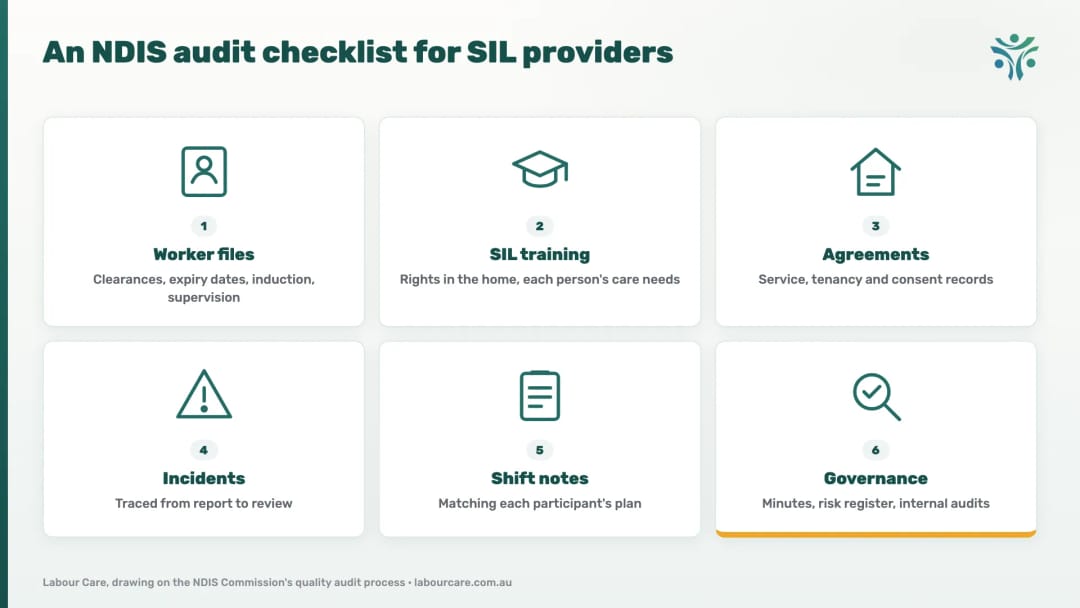
Before you book your audit date, check you can produce these six things.
- Worker files. Screening clearances with their expiry dates, qualifications, induction records, and evidence of ongoing training and supervision.
- SIL training records. Training on participants' rights in their own home, on each participant's individual care needs, and on the practices the SIL standards name.
- Participant agreements and consent. A written service agreement for each participant covering the matters the SIL standard lists, a separate tenancy agreement where you also provide the housing, and consent records.
- Incident and complaints records. Each incident traceable from the first report to the review, including any notification to the Commission.
- Day to day records. Shift notes, handovers and risk assessments that line up with each participant's plan.
- Governance records. Meeting minutes, your risk register, and the results of your internal audits.
The rest of this article takes each one in turn, then covers the step most providers leave until the final week: telling your participants and your staff.
How the audit uses your evidence, and when to start
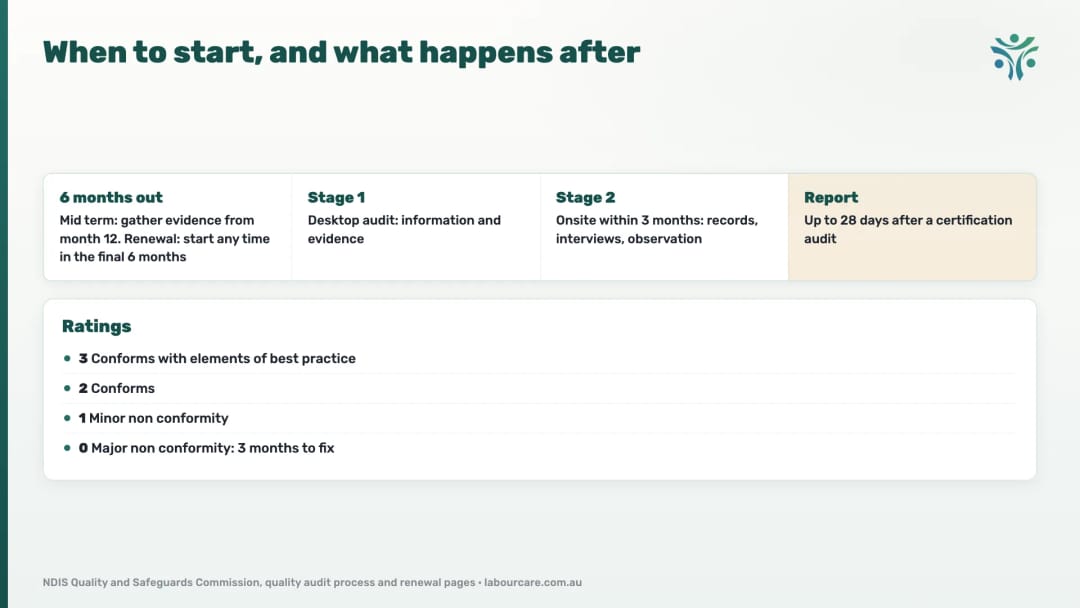
The audit report rates you against each Practice Standard and quality indicator, from 3, conforms with elements of best practice, down to 0, a major non conformity. A major non conformity gives you three months to fix the issue. A minor one gives you longer. For a certification audit, the report goes to the Commission up to 28 days after the audit is completed.
Every one of those ratings rests on evidence. The Commission describes an audit day in its own words, and the line I would pin above every SIL office desk is this one: the focus moves very quickly from what your policies say to what happens in practice. The auditor wants to see incident reports, complaints records, training logs and supervision notes.
The Commission also sets the pace of preparation. If your registration went through a certification audit, a mid term audit falls 18 months into your registration period, and the Commission's own timetable has you gathering documentation and evidence from the 12 month mark. When you renew, you can start the process at any time in the six months before your registration expires, and the renewal includes an audit. That is six months, both times. I would use all of them.
1. Worker files

Auditors sample staff files. The Commission names what they check: NDIS worker screening clearances, qualifications, induction records, and evidence of ongoing training and supervision.
A worker screening check is valid for five years. Registered providers must keep a written record of each worker in a risk assessed role, including the date their clearance expires, and that record has to be kept for seven years. It also has to survive the worker being unlinked from your account in the provider portal.
When I go through worker files, I want to know three things. I want to know that every clearance on this week's roster is current. I want to know that the expiry dates sit somewhere a person checks every month. And I want to know that a new starter's file was complete before their first shift.
If you want more on the renewal side, our worker screening renewal guide covers it, and what you must store and for how long covers the retention rules.
2. Training records for a SIL home
Training is where SIL asks more of you. The SIL practice governance standard expects workers to be trained and assessed as competent in evidence based practices, including person centred and trauma informed practice, active support and supported decision making. It also expects policies and procedures for planning, delivering and evaluating worker training, including mentoring and supervision.
For a SIL home, I look for records showing your workers have been trained on participants' rights and responsibilities within their home, and on the individual care needs of each person they support. Where your workers administer medication, that training record belongs in the file as well.
A certificate shows someone attended. A supervision record and a competency assessment show they can do the work, and those are the records that answer the standard.
3. Service agreements, tenancy and consent
The fourth SIL standard, agreements about tenancy, housing and support arrangements, is the one I see providers least prepared for.
Each participant should be supported to have a written service agreement that sets out how these things will work in their home:
- how their concerns about the home are raised and addressed
- how conflicts with co tenants are managed
- how changes to their circumstances or support needs are agreed and communicated
- how vacancies are filled, with their needs, preferences and situation taken into account
- how behaviours of concern that could put a tenancy at risk are managed, where that applies
- how they can have visitors, safely and without unnecessary restrictions.
If you deliver both the SIL supports and the tenancy to the same participant, the standard expects separate service and tenancy agreements, a policy setting out how you identify and manage the conflict of interest, and a signed copy of the agreement for the participant. Where giving them a copy is not practicable, you record the reason. The full standard is on the Commission's SIL tenancy and housing page, and our article on service agreement mistakes covers the wider basics.
Consent sits in the same file, and I check it in layers. First, consent to collect and store the participant's information. Second, explicit consent for the systems you store it in, including any AI tools you use with it. Third, a record showing the participant was told they can withdraw consent at any time. Consent given today covers today, so the record needs to keep up with the person.
4. Incidents and complaints, from start to finish
In the Commission's own case study of a certification audit, the auditors trace a reported incident from beginning to end: the initial report, the internal review, the actions taken and the notification obligations, checked against your policies.
Run that test yourself on your last three incidents. Can you show the report, who reviewed it, what changed afterwards, and, for a reportable incident, when you notified the Commission? The most serious categories, including death, serious injury, and abuse or neglect, must be notified within 24 hours of you becoming aware of them. Our guide to handling reportable incidents correctly sets out the categories and timeframes.
Complaints get the same test. Auditors ask participants whether they know how to make a complaint, and they explore further when a participant is unsure. Your complaints register should show what came in, what you did about it, and what you changed.
If you use any restrictive practice, the auditor will look in your behaviour support files for the functional assessment, the participant's involvement and the authorisation. We wrote up the reporting steps providers most often miss.
5. Shift notes, handovers and risk assessments
During the onsite visit the auditor watches supports being delivered. They look at how staff communicate, whether consent is sought, and whether the supports match the participant's plan.
Your shift notes and handovers are the written record of the same thing. A note written at the end of the shift, describing the support the plan sets out, is what lets an auditor see your service on all the days they were somewhere else. Risk assessments belong in this pile too: one for each participant, reviewed when something changes, with the latest version easy to find.
Hashim works with providers on the systems these records live in, and when we were talking about spreadsheets he described the risk better than I could.
"You can't answer who was on shift last night, and it's Tuesday night. The spreadsheet got overwritten. There's no history of that document, which means there's no real evidence."
- Hashim Ali, CEO and Director, Labour Care
We covered how auditors connect these records back to your policies in what auditors sample in a SIL service.
6. Governance records
The core module expects your quality management system to include a documented program of internal audits, proportionate to the size and scale of your service. In the Commission's case study, the auditors examine meeting minutes, risk registers and incident trend reports, and ask leadership how risks are identified and escalated.
For a SIL provider with a few houses, this can be small. Minutes that record what was decided about incidents and risks. A risk register that someone updates. The results of your last internal audit, with the actions you took. A short internal audit done every month, and written down, is evidence in its own right. Our guide to running internal audits shows one way to set it up, and what an NDIS consultant does between audits covers keeping it going.
Tell your participants and your staff
Audits sample participants on an opt out basis. You need to let every participant know they are automatically included, which can mean the audit team interviewing them or reviewing their files, records or plans. If a participant chooses to opt out, you respect that decision, document it, and tell the auditor. The Commission's quality audit process page has factsheets you can give participants to explain what happens.
Tell your staff too. The Commission's own preparation steps for a mid term audit include letting staff and participants know that auditors will be visiting and observing your practices. A support worker who knows an auditor might ask how they record an incident will answer with confidence on the day.
Where I would start
If your audit is booked and time is short, this is the order I would work in.
Your worker files come first, because a lapsed clearance is a risk to participants as well as to the audit. Your incident and complaints records come next, because they are the evidence auditors trace from start to finish. Then your service agreements, because the SIL tenancy standard is new for many providers. Governance and day to day records follow.
Our Health Check reviews your documents, registers and records against the Practice Standards you are registered for, and rates every finding purple, red, yellow or green, so you know what to fix first and by when. We will help you to get audit ready, and our audit preparation page sets out how.
Bring us what you have got
Whatever you have got, bring it to us, and we will help you fix it. There is always someone on our team to pick up the phone.
Book a free initial consultation, or get in contact to see how we can fit your budget.
Share this article: