
Most providers meet a consultant twice: when they register, and when the next audit is close enough to be frightening. Everything in between is left to whoever is still in the office at six o'clock.
That gap is where SIL services come unstuck. Not on audit day. In the months before it, when a clearance lapses, a handover is never written down, or the person who kept the incident register leaves and takes the method with them. I have watched good services lose their evidence that way. The work between audits is the work that decides the audit.
What an NDIS consultant does between audits
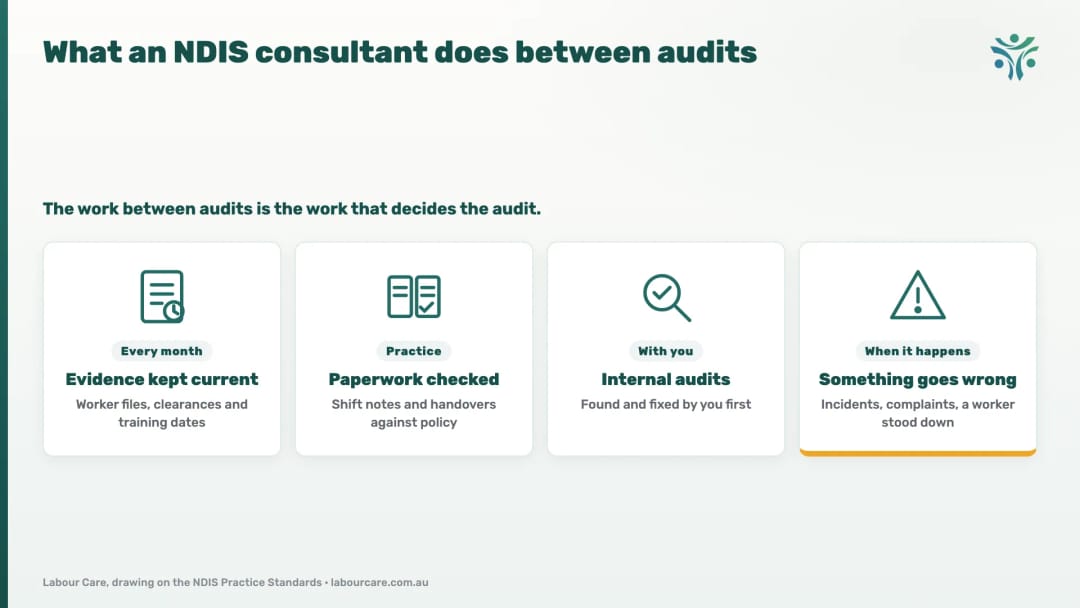
An NDIS consultant who is doing the job properly between audits does four things for a SIL provider.
- Keeps the evidence current. Worker files, screening clearances, training records and the registers the Practice Standards expect you to maintain. We keep your worker files current and chase the expiries.
- Checks that practice matches the paperwork. Shift notes, handovers and incident records are where an auditor sees whether your policies are real.
- Runs your internal audits with you, so problems are found by you and fixed by you, well before an approved quality auditor finds them.
- Is there when something goes wrong. An incident, a complaint, a worker who has to be stood down. That is when a provider needs a consultant most, and it rarely falls in audit month.
What a consultant does not do is run your service. That distinction matters more than anything else in this article, and I come back to it below.
If you want the wider picture of how we work as an NDIS consultant, start there. The rest of this piece is about the months in between.
The audit cycle does not stop at registration
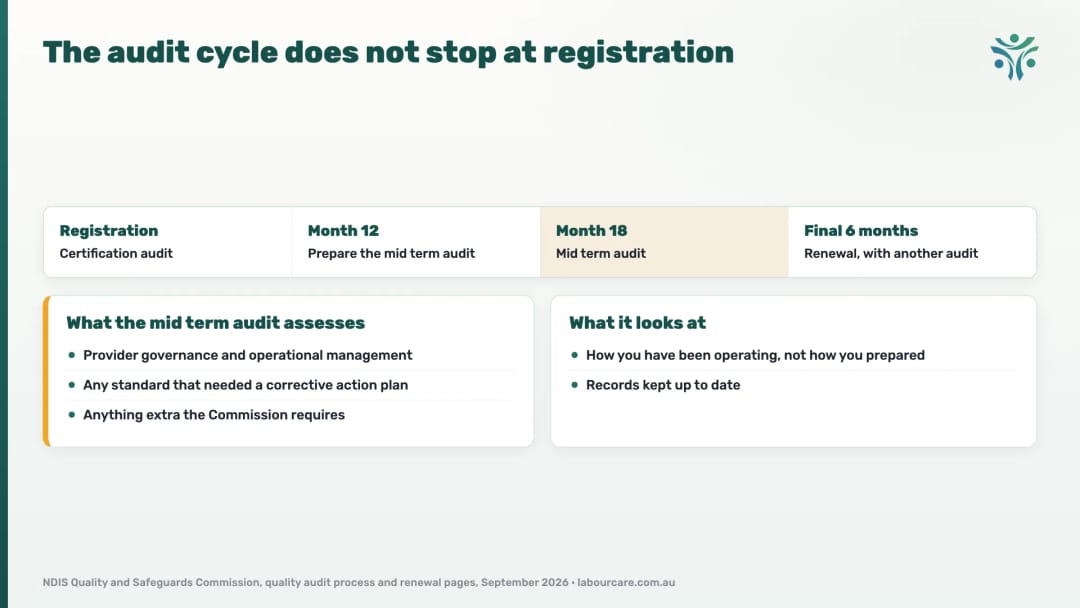
It is easy to think of registration as a finish line. The NDIS Commission describes it as the start of a cycle.
If your registration went through a certification audit, the Commission requires a mid term audit, completed 18 months into your registration period. You prepare for it from around the 12 month mark. It assesses you against the Practice Standards for provider governance and operational management, plus any standard that previously needed a corrective action plan, plus anything else the Commission asks for. The Commission can also impose a condition audit during your registration period, and renewal starts from six months before your registration expires, with the same steps as your first application: worker screening, a self assessment and an audit.
So there is no quiet stretch. There is a governance audit in the middle and another audit at renewal, and both look at how you have been operating, not how you prepared. The Commission's own description of the audit process says the onsite stage looks at how you are implementing your policies and procedures, and it gives providers one piece of advice worth repeating: keep records up to date to support audit evidence and decision making.
For SIL, this now applies to everyone. Supported independent living needs registration group 0138 in your registration from 1 July 2026, which we covered when the Commission confirmed mandatory registration for SIL providers.
Worker files go out of date on their own

Nothing in a SIL service goes stale faster than worker records, and nothing is easier to miss, because a file that was complete last year still looks complete.
An NDIS worker screening check is valid for five years. The Commission requires registered providers to keep an up to date written record of every worker in a risk assessed role, including the clearance expiry date, kept for seven years, and in a form that still exists after the worker is unlinked in the portal. When you identify a new risk assessed role, the written record of roles has to be updated within 20 business days. The governance module adds that records of pre employment checks, qualifications and experience are maintained, and that each worker's contact details are kept up to date.
Clearances are the obvious one. They are not the only one. First aid, manual handling, medication training, and whatever your participants' support plans require of the people rostered to them all have their own dates. In a SIL house with casuals and agency staff, those dates drift apart quickly.
The fix is not a better spreadsheet. The fix is someone whose job it is to look at the dates every month and act on them. A compliance register should stop a lapsed worker being rostered, rather than sending a reminder nobody reads, which is one of the things we look for when choosing compliance software for a SIL service. Between audits, that is the most routine thing a consultant does for a SIL provider, and it prevents findings that should never have happened. Our worker screening renewal guide covers the renewal side, and what you must store and for how long covers the records.
Shift notes, handovers and incidents are where the policies get tested
A policy says what you do. A shift note proves it happened.
When I look at a SIL service, I want to see the operational record at a glance: rosters, attendance, shift notes and handovers, and incident management. If those tell a consistent story, the policies behind them are real. If they do not, no document on the shelf will cover the gap. That is exactly what the onsite stage of an audit is for, and it is why we wrote up what auditors actually sample in a SIL service.
Incidents need particular attention between audits, because two different obligations sit on top of each other. Registered providers must notify the Commission of reportable incidents, and that includes incidents you have already recorded and responded to in your own system. The most serious categories, including death, serious injury, abuse or neglect, must be notified within 24 hours of becoming aware of them. Separately, the governance module expects you to show continuous improvement in incident management: regular review of your procedures, and review of the causes, handling and outcomes of incidents. The same expectation applies to complaints and feedback.
That second obligation is the one that quietly lapses. An incident gets reported, the form is filed, and nobody ever asks what caused it or whether it happened again. A consultant working with you between audits reads the register, looks for the pattern, and makes sure the review is recorded. Our guide to handling reportable incidents correctly covers the notification side in more detail.
One boundary is worth stating plainly. We do not hold your participants' records. Incident reports and progress notes stay in your own systems. We work inside those systems with you, and nothing about the care of your participants lives with us.
When the person who kept it all leaves
This is the scenario I see most often, and it is the one nobody plans for.
In a small SIL service, compliance usually lives in one person. A coordinator or an operations manager knows where the files are, which clearances are due, how the incident register is kept, and what the auditor asked for last time. Then they resign, or go on leave, or get promoted into the role they were actually hired for. The knowledge leaves with them, and the service only finds out when something falls due.
The Practice Standards anticipate this. The governance module expects a documented system of delegated responsibility and authority to another suitable person in the absence of the usual position holder. The continuity of supports standard expects that when a worker is absent or a position is vacant, a suitably qualified or experienced person performs the role. Your records have to survive the person who kept them.
A consultant between audits is part of that continuity. Not a replacement for your coordinator, and not a second set of files kept somewhere else. The point is that the method is written down, the registers are in your system, and someone outside the building knows how they work. When your coordinator leaves, the next person inherits a working system rather than a folder. We covered the record keeping side of this in the requirements providers most often get wrong.
Internal audits are the Practice Standards' own answer
If you only take one thing from this article, take this. The quality management standard expects your quality management system to have a documented program of internal audits, proportionate to the size and scale of your service, and to support continuous improvement using outcomes, risk data and feedback from participants and workers.
That is what between audits is supposed to look like. Not a scramble in the weeks before a mid term audit, but a small, regular check of your own evidence against the standards, with the findings written down and acted on.
In practice, for a SIL provider, a sensible internal audit program samples a handful of worker files each month, a handful of participant files, the incident and complaints registers, and a recent week of shift notes and handovers against the roster. None of that needs to be large. It needs to be regular, and it needs to be recorded, because the record is itself evidence. We set out a fast way to do this in how you can master internal audits.
This is where a consultant earns their keep. We run the first few internal audits with you, show you how we sample and what we look for, and then step back as far as you want us to.
What the Commission expects of anyone using a consultant
The Commission is direct about consultants. If you use a consultant, an advice service or purchased policies for your registration, it expects that you were substantially involved, that you understand what you submitted and can explain it, that your documents are specific to your organisation rather than a copy of a purchased pack, and that you can demonstrate your suitability to deliver supports without relying on the expertise of the consultancy. It also warns that consultants who give the same advice to many providers may indicate a lack of understanding by the provider, and that this can lead to an application being refused. The full wording is in the Commission's guidance on applying for registration.
I agree with every word of it, and it is the best description I have seen of what a consultant is for. The provider has to own the service. A consultant who makes you dependent on them has made you weaker at your next audit, not stronger.
That is why we support rather than take over. Laura, who leads our compliance work, put the reason better than I can when we were talking about how we approach a new provider.
"You've already lost the person that's there to genuinely do something because they feel like you're there to take over."
- Laura Saul, NDIS compliance lead
People come into this sector to make a difference. If a consultant walks in and starts running the place, the person who cares most about getting it right stops owning it. Between audits, our job is to make your systems better and to help you run them your way, not to swap them for ours.
How we scope support between audits
Every SIL service is different, so we do not start with a package. We start with a Health Check: a review of your current systems, registers and records against the Practice Standards that apply to you, producing a gap register ranked red, orange and green against each requirement. That tells us, and you, where the risk actually sits.
From there, providers take one of two paths.
- You run it, with us behind you. You keep the plan, and you have a consultant to call when you need one, with deeper sessions when a project or a problem needs them.
- We carry the admin load inside your systems. We keep worker files current and chase the expiries, maintain the registers, run the internal audit program with you, and prepare the evidence as you go, so a mid term audit or a renewal is not a crisis. You stay in control of the service.
Either way, it is scoped to what you actually need, not a fixed menu. We will help you to get audit ready, and we will help you stay that way. Our compliance support and audit preparation pages set out the detail.
We are a compliance consultancy, not a provider, so we are not competing with you for participants.
Bring us what you have got
I have the detail behind every point in this article, and I keep in contact with the providers we work with long after their audit is done. If you want to know where your SIL service stands before the next audit tells you, bring us what you have got and we will help you fix it.
Book a free initial consultation, or get in contact to see how we can fit your budget.
Share this article: