
Ask ten NDIS consultants how many policies a SIL service needs and you will get ten numbers. I get asked it most weeks, and it is the wrong question. An auditor will give you a better one back.
How many NDIS policies and procedures does a SIL provider need?
There is no set number, and there never was.
There is no set legislation saying you need to have this number of policies. You need the number that is relevant and proportionate to the size of your organisation. If one of your policies can hold what another provider has split across three, and you can justify that for your service, that is absolutely viable.
No schedule in the legislation says a Supported Independent Living provider must hold five policies, or twelve, or thirty. What the law sets instead is a test of proportionality. The NDIS (Provider Registration and Practice Standards) Rules 2018 require, at Schedule 1 clause 9, that a participant's support be overseen by governance and operational management systems "relevant and proportionate to the size and scale of the provider and the scope and complexity of the supports being delivered". Clause 11 applies the same test to your quality management system.
So the question I want you to be able to answer is not "this is the number of policies we have". It is "this is the functional policies and procedure packet that we are using". Those are very different claims, and only one of them survives contact with an auditor.
One caution before you take that as licence to hold less. No instrument sets a number. That is not the same as saying no policies are required. Several are required by name, and for SIL specifically. That is the next section, and it is the part most policy packs skip.
What the NDIS Practice Standards actually require of a SIL provider
The NDIS Practice Standards are built in modules. A core module applies to every registered provider delivering higher risk supports, and supplementary modules apply on top depending on what you deliver. Supported Independent Living is one of those supplementary modules, so a SIL provider is assessed against the core module and the SIL module, not one or the other.
If it has been a while since you read them end to end, start with our NDIS Practice Standards refresher.
The SIL module is four standards, not a document list
The supplementary module for supported independent living sets out four standards:
- Supported decision making
- Safeguarding
- Practice governance
- Agreements about tenancy, housing and support arrangements
Each one is written as an outcome for the participant, not as a list of paperwork. The Safeguarding outcome, for instance, is that each participant "is supported to live in a safe, respectful and supportive home environment". Nothing in the module names a policy count. The module applies to SIL providers who must be registered from 1 July 2026, which we covered when the Commission confirmed mandatory registration for SIL providers.
Where policies and procedures are required by name
Underneath each outcome sit quality indicators. These matter more than the outcome statements, because the Commission is explicit that quality indicators are the things "auditors use to assess compliance with the NDIS Practice Standards". They are published in the Quality Indicators Guidelines, and section 24 of the Rules requires an auditor to take them into account.
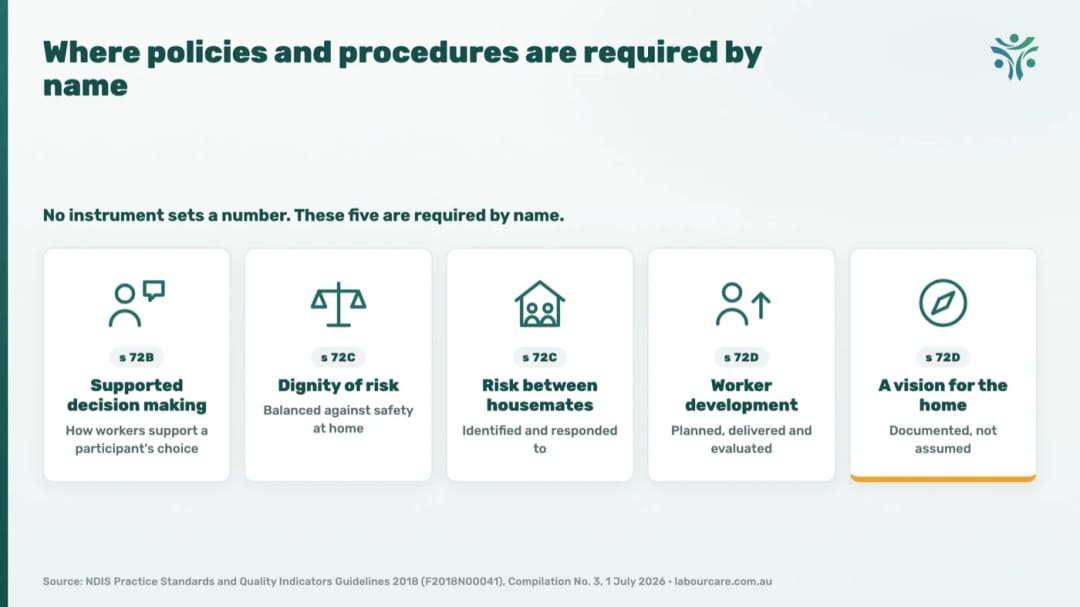
Across the SIL standards, policies and procedures are required in these areas by name:
- Supported decision making requires that "policies and procedures are in place to facilitate supported decision making by workers", and it specifies what they must require of workers: a reasonable period to implement supported decision making, identifying when it may be required, seeking the participant's views on how they want to be supported, responding to cultural values and beliefs, and identifying when an authorised decision maker such as a nominee is needed.
- Safeguarding carries two. One for balancing dignity of risk against your obligations to safety in the home. One setting out worker responsibilities for identifying, assessing and responding to risks such as bullying and conflict between people living in the same house.
- Practice governance carries two as well. One for planning, delivering and evaluating worker development and training. One that must "document a vision, values, objectives and strategies for the delivery of supports and services in the home".
That last one is worth reading twice. It is not a training register or an incident form. It is a statement of what your service is trying to be inside someone's home, and a generic pack will not contain it, because nobody can write it for you.
So the honest answer to "how many policies do I need" is that the count is a decision you make and must be able to justify, while the domains are not optional.
What auditors sample in an NDIS audit
There is not enough time in an audit for anyone to read every document you hold, and it would not tell them much if they did. Auditors sample, and this is not an assumption on our part. Section 5(2) of the Rules states that an assessment "may be conducted by an appropriate sampling method", and section 5(1A) requires the assessment itself to be proportionate to your size, your scale and the complexity of what you deliver. The Commission describes the sampling method for participants as opt out, meaning every participant is included unless they choose otherwise.
What any individual auditor prioritises is not fixed, and I would not want you planning as though it were. What I see them consistently come back to is whether your policies and procedures are current, and whether they align with the recent updates to the NDIS standards. Alongside those: your training records, and your day to day documentation.
The two stages, and where the paperwork stops helping
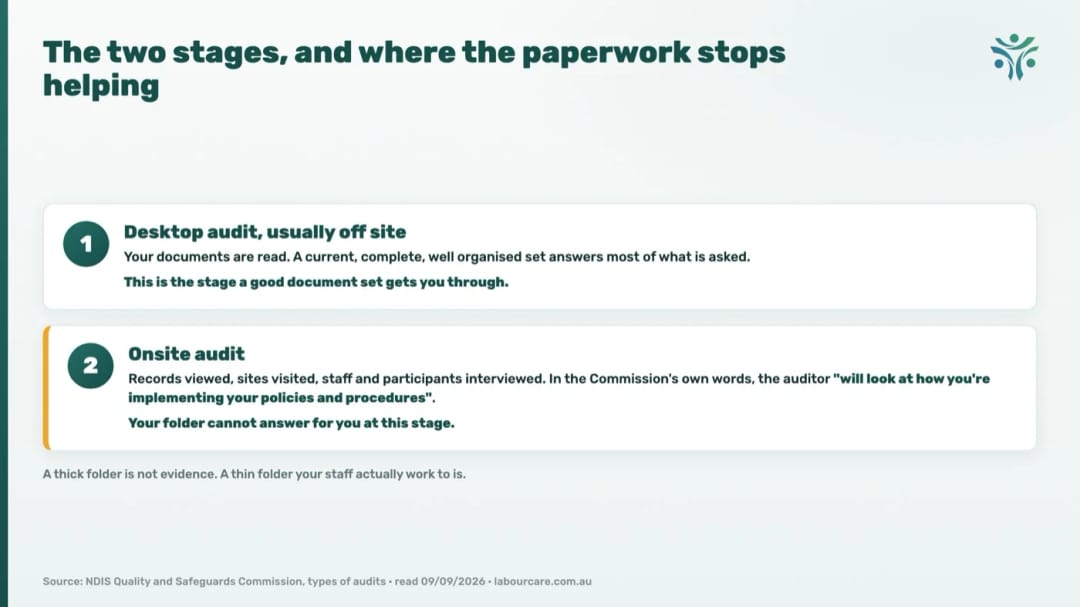
A certification audit, which is the one that applies to higher risk supports, runs in two stages according to the Commission's own description of the process. Your initial scope of audit from the Commission tells you which type of audit you need.
Stage 1 is a desktop audit, usually off site, where the auditor asks for information and evidence. That is the stage a good document set gets you through.
Stage 2 is the onsite audit, and here is the sentence to sit with: "the auditor will look at how you're implementing your policies and procedures". Viewing records, visiting sites, interviewing staff and participants, and observing. Your folder cannot answer for you at that stage.
That reframes the whole exercise. A thick folder is not evidence. A thin folder your staff actually work to is. If you want the practical version of preparing for it, our 10 step audit readiness checklist walks through the evidence an audit asks for.
The SIL records and policies providers most often miss
Training records are the clearest example of what changes in SIL. What an auditor is looking for in the training you provide your support workers is that you have kept current records of training on the participants' rights and responsibilities within the home, and that you are maintaining records showing workers meet the training requirements for that person's individual care.
That expectation is consistent across the sector. What changes in SIL is that the standards name these training guidelines specifically.
Beyond training, a SIL environment pulls in a wider set of documentation than most providers expect when they buy a policy pack:
- Incident management and complaints. Both, and how each works in practice rather than on paper. See handling reportable incidents correctly.
- Restrictive practices, including ones nobody has recognised as such. Be careful with this one, because the test is effect rather than equipment. The NDIS (Restrictive Practices and Behaviour Support) Rules 2018 regulate five practices at section 6: seclusion, chemical, mechanical and physical restraint, and environmental restraint. Surveillance is not one of them, and the instrument does not mention cameras at all. What can bring a camera inside the rules is environmental restraint, which is defined as restricting a person's "free access to all parts of their environment". So the question to ask about a camera in a SIL house is not whether it is authorised, but what effect it has on the person's freedom of movement, and whether they consented. Where a practice does turn out to be an unauthorised restrictive practice, the first step is reporting that you have identified it, then an interim behaviour support plan, its approval, and the reporting that goes with it. We wrote that process up separately: restrictive practice reporting, and what providers often miss.
- Medication management, and whether the workers who administer medication in that property are trained to do it.
- Continuous professional development. Worth being precise here: the Commission sets no minimum number of professional development hours. What the SIL practice governance standard requires is a policy for planning, delivering and evaluating worker development, and evidence that workers are assessed as competent.
- Risk assessments at different levels of the organisation, so participants and staff both know what happens if this occurs and what happens if that occurs.
- Worker screening and current staff records. Clearances expire, and currency is one of the easiest things to check and to be caught out on. See our worker screening renewal guide.
- Participant money. Where a participant has funds available within the SIL, can you show what has been spent and what has come in? Participant money and property is its own standard in the core module, at Schedule 1 clause 25 of the Rules.
- Privacy, consent and information sharing.
- Conflicts of interest, which in a SIL setting can sit inside the housing arrangement itself. Our declare and manage checklist is the short version.
Two more sit alongside these and deserve their own reading. Your service agreements, where the SIL module adds a specific requirement that participants be supported to understand how a tenancy agreement interacts with their service agreement, and we have covered the five service agreement mistakes to avoid already. And your record keeping generally, which is what you must store and for how long.
For the wider set of obligations that sit outside the Practice Standards, see what you must have in place to operate lawfully, and the NDIS Code of Conduct, which the Safeguarding standard requires workers to demonstrate compliance with.
Participant consent in a SIL home is not one signature
Consent in a SIL setting has layers, and providers most often hold only the first.
The first layer is the initial one. Do you have consent to hold and store the information you are storing? The second sits underneath it and is easy to miss: how you store that information, and what you are using to interpret it.
That second layer is moving fastest, because it now includes the tools you process information with. Many services are engaging with AI, and AI systems carry their own consent requirements. So the consent you hold needs to be explicit about your storage systems and about the use of AI. It is a growing field, and a growing problem.
The third layer is the one that gets missed. Consent given at one moment is consent for that moment only. It can be withdrawn at any time, and your records need to show the participant was told that. So each time you provide something like personal care, you want explicit consent at the time the service is provided. What you do not want is a record that amounts to saying the support went ahead because it happens every single day, even though on that day the participant kept saying no.
Consent should be current, up to date, and in the moment. If you are rebuilding this from the start, our participant onboarding guide covers consent, intake and setup together.
Why your staff do not use the policies you already have

Here is what I see in provider files again and again. The real system is a person. There is almost always someone in the service who knows everything about the policies and procedures, and staff ring them instead of looking anything up.
That works until they leave, or they are away for the day.
There are two versions of the failure. In one, nobody can find the document. In the other, the policies exist, they are current, they are correct, everything is in place, and at two in the morning in a SIL house the checklist that needs completing is eleven folders deep in a SharePoint file. Functionally, that is the same as not having it at all.
The first place this shows up is usually an expensive CRM that nobody is using to its capacity. The second is a policy set taken straight from a template and never adapted. Where documentation becomes a signing point rather than something your support workers are actually living, you have the folder and none of the benefit. A template is a starting point. It is sorted in a way that made sense to the person who wrote it, which does not mean it will make sense to you at the moment you need it.
Turning an NDIS policy into a procedure your staff follow
A policy is a starting point. A policy carries a procedure within it. That procedure should link to your safe operational procedures, and those should link to your documents, your forms and your day to day operations. Break the chain anywhere along it and the policy stops describing what actually happens.
You can ask AI for a policy and it will produce one. You can buy a set of documents cheaply or expensively. Either way what you have is a document, and it may not be current, compliant, or suited to your service.
"I would say that most providers we meet have the policies. They're not usually the problem. The problem is the gap between what the document says and what happens on shift. And that's the gap an auditor goes looking for."
- Hashim Ali, Labour Care
The Commission's own description of a Stage 2 onsite audit says the same thing in regulator language: the auditor looks at how you are implementing your policies and procedures.
So when you are buying a policy pack, the question worth asking is not how many documents are in it. It is whether you are buying the documents, or buying the time to make those documents fit your organisation.
We help providers close that gap. Not by selling you another folder, but by making sure your staff are actually working to what you have already written. That is what our compliance support and operational packs are for, and if an audit is what is driving the question, our audit support starts from where you already are.
We are a compliance consultancy, not a provider, so we are not competing with you for participants.
Bring us what you have got
If you are not sure whether your SIL documentation would hold up to sampling, bring us what you have got, and we will help you fix what you have got.
Book a free initial consultation, or get in contact to see how we can fit your budget.
Share this article: