
When I look at a provider's group program, the question I keep coming back to is a simple one. Did it happen, and can you show it?
Most of the group programs I see are good. Participants turn up, the activity runs, people enjoy themselves and the workers know everyone by name. You are probably already recording some of that, so keep doing it. This is what I would add, so that your records show the day the way it happened to the participant, their family, their plan reviewer and anyone who audits your service.
What NDIS group activities records can show
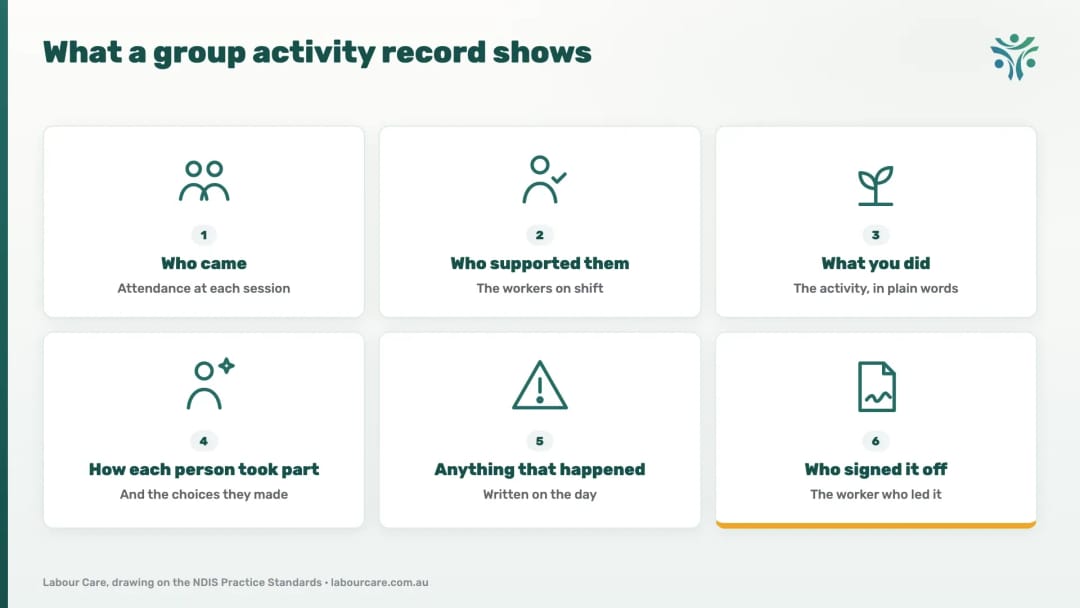
A good record of a group activity answers six questions:
- who came
- who supported them
- what you did
- how each person took part, and the choices they made
- anything that happened
- who signed it off
The Practice Standards set an information management outcome for every registered provider: each participant's information is identifiable, accurately recorded, current and confidential, and easy for the participant to access. They also ask for an information management system that is relevant and proportionate to the size of your organisation and records each participant's information in an accurate and timely manner.
For a group program, that means a record for the session and a line in each participant's own file, written on the day.
Who came, and who supported them
Record attendance for each person at each session. If someone arrived late, left early or did not come, write that down too, with the reason where you know it. A session record that lists everyone who was booked tells you less than one that lists everyone who was there.
Record the workers as well. Who was on shift, who supported which participants, and who was leading the session. If someone stepped in partway through, or a worker supported one participant one to one for part of the day, record it.
Together, those two lists let your attendance, your staffing and what you claimed for the session line up with each other. When I review a group program, that match is one of the first things I look for.
What you did, and how each person took part

Write down what the group did, in plain words. A walk along the creek, lunch at the picnic shelter, planting out the vegetable beds at the community garden.
For each participant, add a sentence or two on how they took part. People join in their own way, and the record should show that. One person led the group on the walk. Another chose to sit out the walk and help set up lunch. Someone spent the afternoon talking with a friend they had not seen in weeks.
Those choices belong in the record. The Practice Standards ask that each participant is supported to make informed choices and exercise control, and that supports meet their needs, desired outcomes and goals. A note that connects the day to what the participant is working towards is what turns an attendance list into evidence of support.
Anything that happened
Record anything out of the ordinary on the day, while it is fresh: an incident, a near miss, a participant who seemed unwell or not themselves, a change in plans and why.
Your incident management system covers what happens next. The Practice Standards ask for one that is relevant and proportionate to your supports and the size of your organisation, and that complies with the Incident Management and Reportable Incidents Rules. The group record is where it starts. Our guide to incident management and reportable incidents covers the rest of that process.
Capture it while the activity runs
The record is easiest to write, and most accurate, on the day. A short session sheet or a form in your system, filled in as the group wraps up, works for most programs. Give one worker the job of completing it each session, and give them the last ten minutes of the shift to do it.
Your rostering and records system can do a lot of this work for you.
"In terms of seeing things at a glance ... you would want to be able to see information ... accurately, for you to be able to make the right decisions about rosters ... attendance proofs, shift notes and handovers, as well as incident management."
- Hashim Ali, CEO and Director, Labour Care
If you are still choosing a system, our post on choosing compliance software sets out what to look for, and most of it applies to group programs too.
Voice notes and photos, with consent
Voice notes and photos can make a record richer, and a photo of a great day can mean a lot to a participant and their family. They are part of a participant's personal information, so they need the participant's consent.
The Practice Standards ask that each participant understands and agrees to what personal information will be collected and why, including recorded material in audio and visual format, and that they know how it is stored and used. So ask each participant, record their answer, and keep voice notes and photos in your business system with the rest of their record. A photo that stays on a worker's phone, or goes into a group chat, ends up on every phone in that chat.
Some participants will say yes to photos and no to voice notes, or yes on some days and not others. Record what they chose, and respect it every session.
Who signs it off
Have the worker who led the session read the record and sign it off on the day. If something needs correcting later, add the correction with the date and who made it, and keep the original.
That signature is what tells a plan reviewer or an auditor that someone who was there stands behind the record.
Let participants and families see the record
A group record is about the participant, so they can see it. The Practice Standards ask that each participant's information is easily accessible to them, and that each participant knows how it is stored and used, and when and how they can see it, correct it, or change what they agreed to.
In practice, tell each participant when they join the group that they can ask to see their record at any time, and make it easy to do. Some will want a family member to see it too. Others will want their family kept out of it. Their consent decides who else sees their information, so record who they are happy for you to share it with, and check it each time you send something.
A short note home after a good day, sent with the participant's agreement, is one of the nicest things a group program can do. It also tells a family the program is running the way you said it would.
Keep the records safe and easy to find
Keep each participant's group records in one place, in your business system, alongside the rest of their file. The Practice Standards ask for documents to be stored with processes for access, security, retention and disposal that fit the scope and complexity of your supports.
For most group programs that means a session record you can pull up by date, and a participant record you can pull up by name, with both pointing at each other. Our post on what providers must store and for how long covers retention in more detail.
Look across the month
Once a month, read back over the group's records together with whoever coordinates the program. You are looking for the story the records tell over time. Who has come every week, and who has stopped coming. Which activities people chose, and which ones they sat out. Whether anyone's notes show them moving towards their goals.
Take what you find to each participant's next review, and ask them what they would like more of. That conversation is where the record does its best work, because it gives the participant a say in what the group does next.
Bring us what you have got
Whatever you are recording now, bring it to us and we will help you build on it. Our Health Check reviews your documents, registers and records against the Practice Standards you are registered for, and rates every finding purple, red, yellow or green, so you know what to work on and by when. There is always someone on our team to pick up the phone.
Book a free initial consultation, or get in contact to see how we can fit your budget.
Share this article: