
When I look at the photos a group program takes, I ask three things. Did the person want it taken? Was it the right moment? And where did that photo go?
A photo of a great day out is a lovely thing. Participants keep them, families treasure them, and they show the life a program makes possible. Keep taking them. This is how I would set your program up so that every photo is one the person wanted, taken at a good moment, and kept somewhere you control.
Photo consent in an NDIS group program
A photo of someone who can be identified is their personal information. The Office of the Australian Information Commissioner lists photographs among its examples of personal information, and whether something counts turns on whether the person is reasonably identifiable.
The NDIS Practice Standards say the same thing in their own words. Under privacy and dignity, each participant understands and agrees to what personal information will be collected and why, including recorded material in audio and visual format. A photo is visual material. The NDIS Code of Conduct asks everyone delivering supports to respect the privacy of people with disability, and their right to make their own decisions.
So photo consent belongs to the participant. You ask them, in a way they understand, and you record what they said.
What a photo consent form covers
Most providers already take photo consent at intake, and that is the right place to start. When I read a photo consent form, I want it to show:
- what the photos are for, with a separate yes or no for each use: a keepsake for the participant, sharing with their family, your program records, and anything public such as your website or social media
- who will see them
- where they will be kept, and for how long
- how the participant can change their mind, and who to tell
A separate answer for each use matters. Plenty of people are happy for their mum to see a photo of them at the beach and would rather it stayed off Facebook, and a separate yes for each use lets your form record exactly that.
Your participant onboarding is where this form usually sits, alongside the other consents you collect at the start.
Ask in the moment too
Consent given at intake is consent at that point in time, and a participant can withdraw it whenever they choose. A yes on a form in March tells you how someone felt in March.
So on the day, ask. "Would you like a photo of this?" takes a few seconds, and the answer tells you what the person wants right now. Ask in the way that person communicates, whether that is words, a picture card, a sign or a nod, and watch for the answer as well as listening for it. Where a participant would like a family member or another supporter to help them decide, bring that person in.
When someone says no, or turns away from the camera, that is their answer for today. Put the phone away and carry on with the activity.
Four questions for every photo
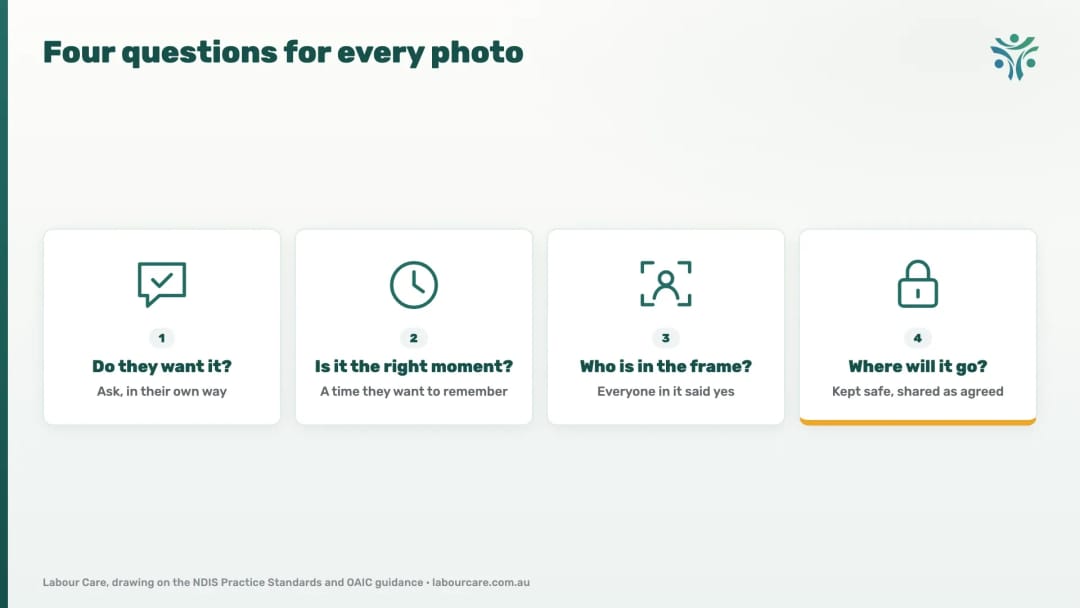
Here is the short version I would give every worker on a group activity. It fits on a lanyard card, and it covers everything above.
- Does the person want it?
- Is it the right moment?
- Who can be identified in it?
- Where will it be kept, and who will see it?
The right moment for a photo
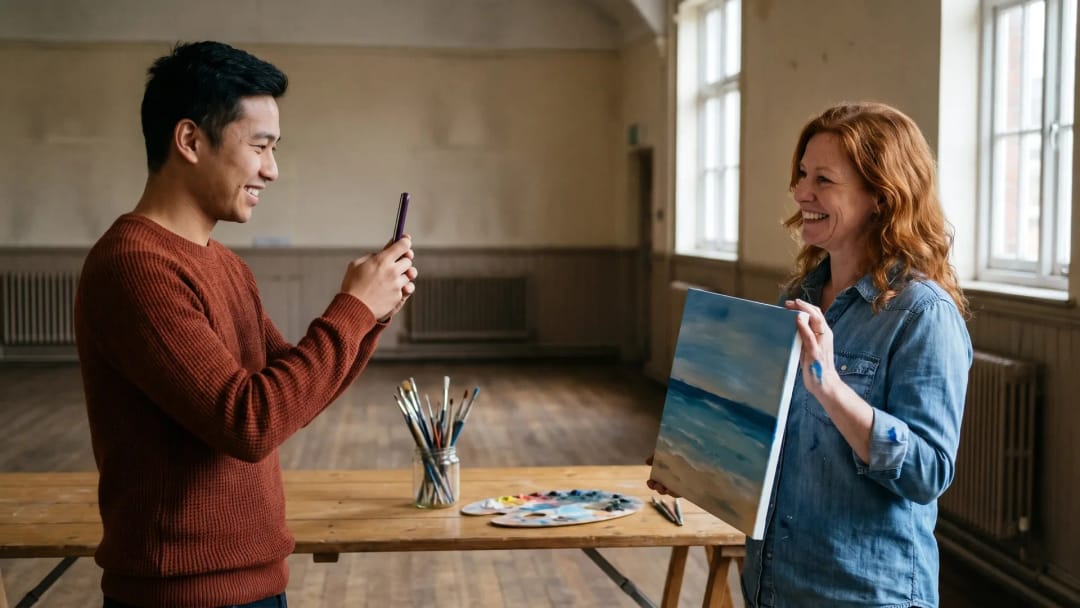
The best photos in a group program are the ones the person asked for. A participant proud of a painting they finished, a group laughing at the end of a walk, a first go at something new. If someone is having a great time and wants a photo to remember it, take it.
When a participant is distressed, the moment belongs to supporting them. A camera pointed at someone who is upset can make things harder for them, and their distress is a time for care and calm. If something happened that needs recording, record it in words, in your notes, afterwards. That is where your program's records of what happened belong.
A photo kept for your records follows the same rule as any other: the participant agreed to it, and you can say why you took it.
Who can be identified in the frame
A group photo holds more than one person, and each of them has their own say. When you share a group shot, check that everyone who can be identified in it agreed to that use.
Faces are the obvious one. Other details can identify someone too: a name on a lanyard, a house number behind them, a school or workplace logo, a car's number plate. Where someone in the group said no to photos, frame the shot so they are out of it, or choose a different shot.
Photos that show the activity without showing who was there can be a good option for your own records and for public posts. Hands on a pottery wheel, paint on a palette or the view from the top of the walk all tell the story of the day.
Where did that photo go?
This is the question I would ask about every photo your team takes.
A photo taken on a worker's own phone lives on that phone, and often in that phone's cloud backup too. Share it to a group chat and it is now on the phone of every person in that chat. A photo in a WhatsApp group with ten members is ten copies you no longer control.
What I would put in place:
- a work phone or a work app for program photos, so they are taken on something your business controls
- a regular routine of moving photos into the participant's file or your secure storage, and clearing them from the device
- family sharing through a channel you choose, sent to the people the participant said yes to
- group chats used for the logistics of the day: times, meeting points and who is driving
Your record keeping covers how long to keep what you store, and photos sit inside it like any other record.
Photos on your website and social media
A public post is the widest share there is. Once a photo is online, anyone can save it, and it can turn up in places the participant never pictured. So public use gets its own yes on the consent form, separate from family sharing and your records, and a fresh check on the day the post goes up.
When you do post, a few habits keep it respectful:
- show the activity and the fun of the day, and keep each person's support needs out of the caption
- use a first name only where the person has said yes to that, or no name at all
- check every face in the frame against your consent records, the people in the background included
- when someone asks for a photo to come down, take it down that day and let them know it is done
Participants and their families follow provider pages too. A post that shows people enjoying their day, with their say respected, tells them a lot about how your program works.
Building it into your program
Three things keep this steady as your team and your participants change. A few lines in your privacy policy on how your program takes, keeps and shares photos. A photo consent form with a separate answer for each use. And a short walk through with every worker who runs a group activity, so the four questions travel with them.
Keep it relevant and proportionate to the size of your program. For a small group, that can be a paragraph and a one page form.
Bring us what you have got
Whatever you have got, bring it to us, and we will help you fix it. Our Health Check reviews your documents, registers and records against the Practice Standards you are registered for, consent and privacy included, and rates every finding purple, red, yellow or green so you know what to look at first. There is always someone on our team to pick up the phone.
Book a free initial consultation, or get in contact to see how we can fit your budget.
Share this article: