
Most software conversations start in the wrong place. A provider opens a comparison table, reads forty feature names, and tries to work out which of them matter. By the end of the demo they know what the product does. They still do not know whether it will hold up on a Tuesday night in a Supported Independent Living house.
I have grown services through that decision and cleaned up after it. There is a better first question, and it is not about features.
What NDIS compliance software has to cover for a SIL service

Start with categories, not features. A feature list is written to win a comparison. A category list is written from the work you actually have to do, and it is much shorter.
For a SIL service the categories are:
- One core platform holding participants, staff and shifts. Not three places where the same person is recorded differently.
- Something that understands SIL ratios, rather than treating every entry as a shift.
- Award interpretation that survives your worst roster week. Not your average week. Your worst one.
- A compliance register that blocks a lapsed worker from being rostered, instead of emailing someone a reminder that nobody opens. Worker clearances expire, and expiry is one of the easiest things to be caught out on. Our worker screening renewal guide covers the currency side of that.
- Claiming against the right line items and ratios, so that what was delivered and what was invoiced are the same thing. If claiming is where your errors sit, start with how the support catalogue affects claiming and avoiding errors in bulk payment claims.
- Learning and training records held in a learning system, not as PDFs in a folder. Training is evidence, and evidence has to be findable. See five steps to boost your team's skills.
Then there is the question a demo will not answer for you, and it is the one that decides whether any of the above happens: what does a support worker see on their phone at six in the morning? That is where adoption lives or dies. A system nobody opens on shift is a system you are paying for and not using.
The three systems a SIL provider actually needs
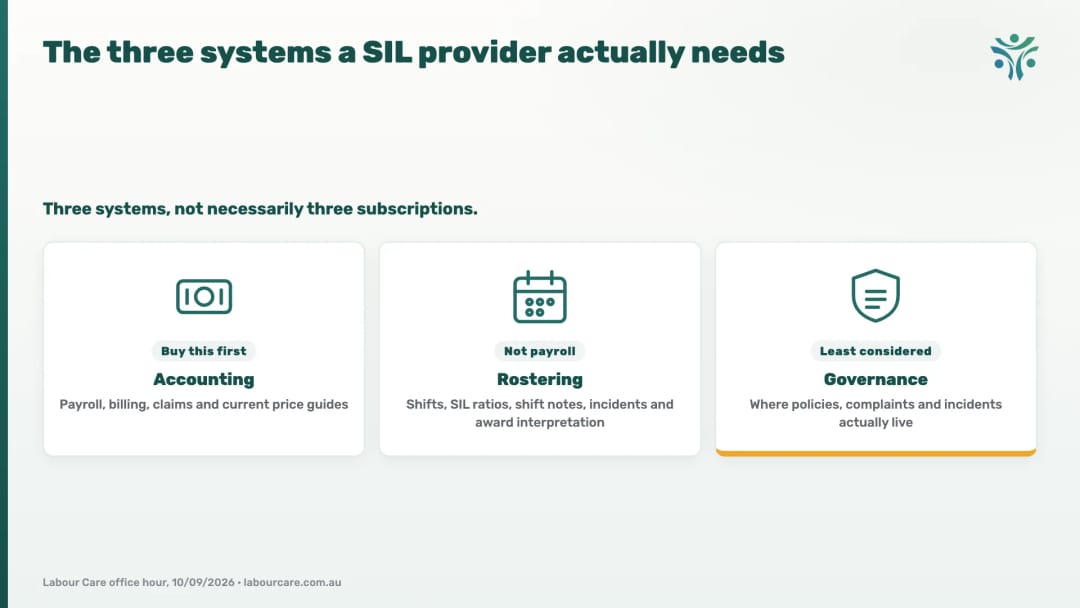
Underneath the category list, most SIL services end up running three systems. Sometimes they are three products. Sometimes two of them sit inside one.
One, your accounting system, and for many providers this carries payroll and billing as well. The common accounting platforms roll accounts payable, accounts receivable and fortnightly payroll together, which lets you run the same system across contractors, casuals and full time staff. If you are only ever going to buy one system, this is the one to buy, and in principle everything else can sit on paper behind it.
Two, your rostering system, which is where shifts, shift notes, case notes and incident reporting live. This is a different job from payroll. A payroll system will rarely send out schedules, and schedules matter because they are how a worker knows what documentation the shift requires of them.
Three, your governance system. Complaints and feedback, staff performance management, incident management, and the place your policies and procedures actually live. In most services this is a document store rather than a purpose built product, and it is almost always the least considered of the three. It is also where your record keeping obligations land, which we set out in what you must store and for how long and the parts providers most often get wrong.
Whether those three are three subscriptions or one depends on the size and scope of your organisation. That is a real answer, not a hedge.
What to look for when you are choosing
Four things are worth more than any feature comparison.
Will it grow with the organisation? A system that is cheap to start with and expensive to scale is not a saving, it is a deferred cost. If the pricing model punishes you for growing, it is the wrong system for a service that intends to grow.
Is it fit for purpose? A lot of platforms promise to do everything, and that is not automatically a good thing. One system that does one thing extremely well can beat one system that does nine things adequately. Running several specialised systems is sometimes the better answer, not a sign of a mess.
Is it genuinely connected to the NDIS price guide and pricing standards? Not a claim on a website that it supports NDIS pricing, but current price guides and a commitment to keep them current. A vendor who keeps pace with pricing changes is telling you they understand the scheme. A vendor who does not is telling you something too. Pricing keeps moving, as the three year pricing workplan sets out.
Can it give the right information to the right staff member, rather than giving everyone access to everything? That one deserves its own section, below.
Why I will not tell you which product to buy
I get asked which platform to use constantly. I do not answer it, because I cannot know from outside your service.
Every provider is different, and recommending a product without understanding the business is how providers end up paying for something that does not fit. One provider runs on spreadsheets where every cent and every movement is tracked, and it is working. Another has an expensive platform nobody uses past its rostering screen. The first provider does not need to be rescued. The second does not need a new product.
The category matters more than the brand. And the brand matters less than whether your staff open it.
When spreadsheets stop working, and what they are still good for
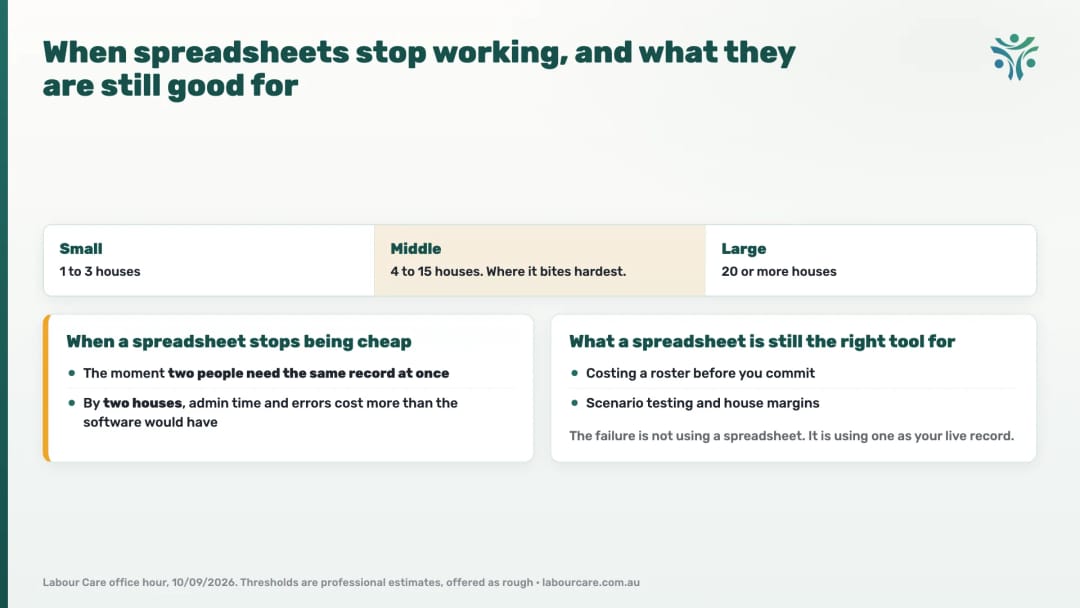
There is a size at which a spreadsheet stops being thrifty and starts being a liability. It is earlier than most providers think, and it is not really about participant numbers.
It is about concurrency. The moment two people need the same record at the same time, a spreadsheet sitting on one person's computer and emailed around as a live document becomes the thing standing between your team and their work.
As a rough threshold: beyond one house, or somewhere around ten to fifteen staff, spreadsheets stop being cheap. By two houses the cost in admin time, hours and errors is usually higher than the software would have been. Providers tend to fall into three bands, and the middle one is where this bites hardest: one to three houses, four to fifteen houses, and twenty or more.
The failure mode is specific, and it is an evidence failure rather than an efficiency one. It is Tuesday, and you cannot answer who was on shift last night, because the spreadsheet was overwritten and there is no history of the document. No history means no evidence. That is a very different problem from being slow.
None of which means a small provider needs a full platform. I will not sell you a spaceship when what you need is a skateboard to get from A to B.
For a small provider the skateboard is often a shared document platform where the team can work on the same file at once, with version history, hosted somewhere you can account for. That is a genuine upgrade over an emailed spreadsheet and it is not a CRM.
And spreadsheets keep a real job. They are good at modelling: costing a roster of care before you commit to a service, scenario testing, working out house margins, pulling data out for analysis. That work is worth doing in a spreadsheet. If you are costing SIL, our five checks before you submit a quote covers the quoting side. The failure is not using a spreadsheet. It is using one as your live record.
What your rostering system has to prove about skills mix
Skills mix is the part of rostering that most systems record badly, and it is the part an auditor can ask about.
Every support worker is an individual with strengths and weaknesses, and your system should capture what those strengths actually are. If a worker supports high intensity participants, you want the skills that justify them working in that scope recorded, with the training behind it. Where a participant needs a combination of high physical and psychosocial support, they may need a combination of workers, and the reasoning for that combination should be visible.
Some of what makes a good match is not on a certificate. Language, and whether a worker fits a culturally and linguistically diverse participant's needs. Whether a participant has asked for a worker who is safe for them as an LGBTQ person, and how you met that request. Shared interests, similar values, the things that make someone feel comfortable in their own home. Every participant has the right to be supported by someone who both supports their decisions and makes them feel safe.
So the practical test of a rostering system is whether it can hold that. Can it record which workers are approved to work with which participant, what their clinical training is, and a written summary of the softer skills that are not captured by a piece of paper? Some of the better known systems can. If yours only records who was on shift, you can describe your skills mix, but you cannot show it.
Access has to close as well as open
Most providers set up access once, when a worker starts. The harder half is closing it.
A participant has choice and control over who supports them, and that choice can change. If a participant asks that a particular worker no longer works with them, access to that participant's information needs to stop at that point. Each person should hold access to the information their role requires, for the participants within the scope of their role, at that time. Not the whole system, and not indefinitely.
This is also why "everyone can see everything" is not a neutral configuration. It is a decision, and it is one you would have to defend. The same logic runs through conflicts of interest, which in a SIL setting can sit inside the housing arrangement itself, and through consent at intake.
Where your participant data lives, and who can be compelled to hand it over
This is the section of a software decision that providers skip, and it is the one with the sharpest edges.
Participant information is not ordinary business data. Health information is defined as sensitive information under the Privacy Act 1988 and carries extra protection under the Australian Privacy Principles. A business that provides a health service and holds health information does not get the small business exemption from the Act, whatever its turnover, so "we are too small for privacy law" is not a position that holds. The regulator's guide to health privacy is the place to start on that. And before personal information is disclosed overseas, Australian Privacy Principle 8 sets out steps an entity must take to protect it. The regulator's own summary of APP 8 is exactly that: it "outlines the steps an APP entity must take to protect personal information before it is disclosed overseas".
That has three consequences that a feature list will never show you.
Where the data is stored. If anything you hold could be considered health information, you want to know which country the server is in, and you want to know it before you sign, not after a breach.
Where it is processed and backed up. Storage and processing are not the same question, and backups are frequently in a third place.
Who can be compelled to hand it over. This is the question almost nobody asks a vendor, and it is the one that decides how much control you actually have.
Two situations bring this to the surface faster than any audit. The first is offshore admin support. When participant information is shared with assistants or admin staff based overseas, private information has left the country, and that is a disclosure with obligations attached. The second is AI. Putting participant details into a general purpose AI tool without removing the identifying information is a disclosure too, and the question to ask is whether what you type is being used to train a model, and where that model's data sits. It is a fast moving area and a growing problem.
There are ways through it. Keeping data in Australia, controlling remote access properly, or running language models locally so an organisation stays the custodian of its own information and still gets the benefit. There is a cost to that, and it is not right for every provider. If you are moving onto a digital platform, the transition pathway for digital platform providers is worth reading alongside this.
What compliance software will not do for you
No platform makes a service compliant. It makes a compliant service easier to run and an uncompliant one easier to see.
It will not write your policies, and it will not tell you whether the ones you hold are the right ones for your service. It will not decide your skills mix, only record the decision you made. It will not consent on a participant's behalf. It will not tell you that the data you just typed into a chat window has left the country. And it will not get your team to use it, which is the failure that undoes most software purchases well before any audit. If an audit is what is driving this, the 10 step audit readiness checklist starts from the evidence side rather than the software side.
Which leads to the question I get asked most, usually as "if I can only fix one system, which one?" I put it to Laura, who runs our compliance work, because she sees the answer in provider files every week.
"If you are paying for a system and you're not using it to the maximum, that is the system I'm going to fix first. Because otherwise you can throw money down a pit."
- Laura Saul, NDIS compliance lead
Not the newest gap. The system you are already paying for. If you have a platform doing rostering and nothing else, when it could also be capturing who has read the shift plan, the emergency procedure, the risk assessment and the care plan, then the return is in using what you own, not in buying something else. After that, the one worth investing in is usually governance, because it is the system you keep improving, and because a set of files nobody can navigate is a set of files you are paying homage to rather than using.
That is also why we start with a look at the whole picture rather than a product recommendation. Which system to fix depends on what you are already running, and that is worth assessing before anyone spends money on a subscription. Our compliance support and operational packs work from where you already are, and the wider NDIS consulting picture sets out how we work.
We are a compliance consultancy, not a provider, so we are not competing with you for participants.
Bring us what you have got
If you are not sure whether the systems you are running would stand up to an audit, or whether you are paying for three platforms doing one job, bring us what you have got and we will help you fix what you have got.
Book a free initial consultation, or get in contact to see how we can fit your budget.
Share this article: