
When I open a SIL provider's service agreements, the first thing I want to know is whether the agreement describes the house I am about to walk into. Who lives there, how support is given, what happens when something changes. If the agreement could belong to any provider in the country, it will not hold up for long once an auditor starts asking questions.
SIL providers must be registered from 1 July 2026, and the Practice Standards that come with registration have more to say about service agreements than most providers expect. There is the core module, which applies to every registered provider, and there is a SIL standard on agreements about tenancy, housing and support arrangements, which applies to you specifically.
This is how I read a SIL service agreement against both, clause by clause, and where I see them fall short.
Do SIL providers need a written NDIS service agreement?
If you read the NDIA's participant guidance on its own, you could reasonably say no. Its page on service agreements tells participants they are not required to create a written agreement in most cases, recommends one every time they start with a new provider, and says written agreements are only mandatory for specialist disability accommodation.
For a registered SIL provider, I would plan for one in writing. The SIL standard on agreements about tenancy, housing and support arrangements says each participant is supported to have a written service agreement that sets out six specific matters about life in their home. That is the standard you are audited against.
Those two positions sit together comfortably. The NDIA page is guidance for participants about the scheme as a whole. The Practice Standard is what an auditor will hold your SIL service to. And the core module already expects a signed copy for the participant wherever the agreement is in writing, or a record of why they did not receive one.
Our article on common service agreement mistakes covers the basics every provider needs. Everything below is what SIL adds.
The clauses an auditor looks for in a SIL service agreement
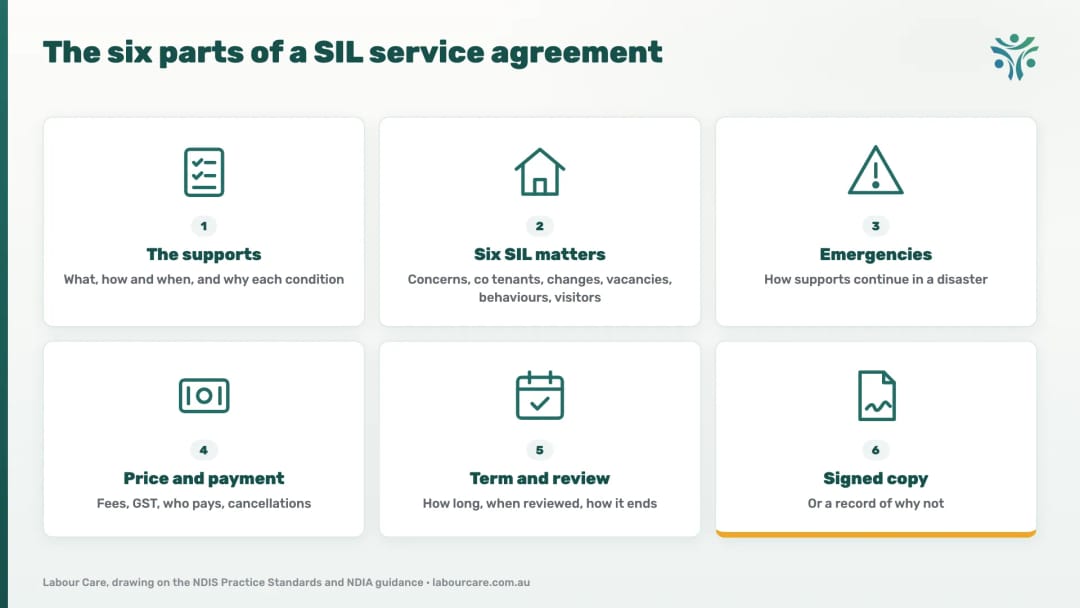
I work through a SIL agreement in six parts. Each one traces to a quality indicator or to the NDIA's own description of what a good agreement covers.
- The supports, and the conditions on them. What will be delivered, how, when and where, and any conditions attached, with the reason for each condition.
- The six SIL matters. Concerns about the home, conflicts between co tenants, changes in circumstances, vacancies, behaviours of concern, and visitors.
- Emergencies and disasters. How supports will continue if something goes wrong in the house or in the community.
- Price, payment and cancellation. What the participant pays, how you are paid, and your cancellation policy.
- How long it runs and how it ends. The term, when it will be reviewed, how changes are agreed, and how either side can end it.
- The signed copy. A copy signed by both of you in the participant's hands, or a record of why that was not practicable.
The first and the last come from the core module on service agreements with participants. Its outcome is that each participant has a clear understanding of the supports they have chosen and how they will be provided, and it expects the agreement to be developed together with the participant.
The supports, and why each condition is there
The core module asks for a service agreement that "establishes expectations, explains the supports to be delivered, and specifies any conditions attached to the delivery of supports, including why these conditions are attached."
That last part is where I find gaps most often. An agreement says the participant must give notice before changing their routine, or that certain supports are only available at set times, and it never says why. Without the reason, the condition reads as a house rule imposed on the participant, and an auditor will ask whether the participant agreed to it or simply signed it.
So for every condition in your agreement, I want to know two things. Can you explain the reason in one plain sentence? And is that sentence in the agreement?
The six SIL matters, in the participant's own home
The SIL standard lists six matters a participant's written service agreement should set out:
- how their concerns about their home will be communicated and addressed
- how potential conflicts involving co tenants will be managed
- how changes to their circumstances or support needs will be agreed and communicated
- how vacancies will be filled, including their right to have their needs, preferences and situation taken into account
- how behaviours of concern that may put tenancies at risk will be managed, where this is relevant for the participant
- how they can have visitors in their home, and how they will be supported to do that safely without unnecessary restrictions.
Each of these needs to describe this house and this participant. A vacancy clause in a shared home of four reads very differently from one in a home of two, and the participant should be able to see how they will be involved when someone new is being considered.
Visitors is the matter I see left out most. It is easy to treat as obvious, and it is where an unwritten house rule can quietly become a restriction. If your agreement is silent on it, that is where I would start.
Behaviours of concern needs care in the other direction. Where a participant has a behaviour support plan, the agreement should sit alongside it and be consistent with it. Our article on implementing behaviour support plans goes into what that plan has to do.
Emergencies, price and the end of the agreement
The core module also says service agreements set out the arrangements for providing supports in the event of an emergency or disaster. For SIL, where you are supporting someone in their home every day, this clause matters more than for almost any other support. I want to see what happens to supports if workers cannot reach the house, if the house cannot be used, or if the participant needs to move for a time. Our guide to emergency management planning covers the wider plan the clause should point to.
The commercial clauses come from the NDIA's own list of what a good agreement includes. The price the participant will pay, any other fees or charges, whether GST applies, and how you will be paid, whether by the participant, through direct claims on an NDIA managed plan, or by a plan manager. Your cancellation policy. The rules each of you need to follow, and what either of you can do if those responsibilities are not met.
Then the life of the agreement. The NDIA lists what a participant should know: how long the agreement goes for, when it will be reviewed, how changes will be managed and how to end it. I would add one thing for SIL. When a participant ends their SIL agreement, the agreement should make clear what that means for their housing, which brings us to tenancy.
Keep the service agreement and the tenancy agreement separate
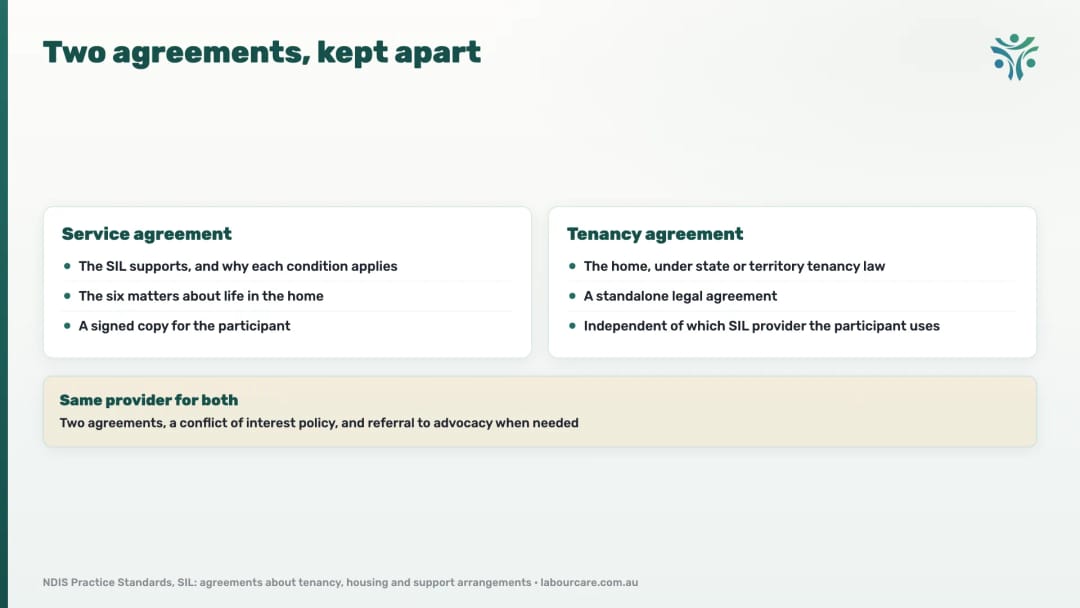
If you provide both the SIL supports and the tenancy to the same participant, the SIL standard expects two separate agreements. The participant should be supported to understand that they are legally separate and that one does not depend on the other, and your workers should refer them to independent advocacy or legal assistance where they need help understanding their rights.
You also need policies and procedures setting out how you identify and manage a perceived or actual conflict of interest when you provide both, made available to participants in a form they understand. Our conflicts of interest checklist is a good place to begin that policy.
The Commission's own example makes the point clearly. A participant whose SIL provider also owns his home becomes unhappy with how his supports are delivered and wants to change provider, and he is told he may need to move out. The example's outcome is that he changes SIL provider and stays in his home under his tenancy agreement, and the change only affects his SIL arrangement.
So I read your two documents side by side and ask a simple question. If this participant ended their SIL agreement tomorrow, would anything in either document put their home at risk? If the answer is yes, or if it is hard to tell, the agreements need work.
The same standard also expects participants to understand their right to change their SIL provider, in whole or in part, at any time during their tenancy, with participant centred arrangements in place to make that possible.
If the home is specialist disability accommodation
Where you deliver SIL in a specialist disability accommodation dwelling, the core module adds a third party. It expects documented arrangements with each participant and with each SDA provider, naming who is responsible for how concerns about the dwelling are raised, how conflicts are managed, how changes are agreed, how vacancies are filled in shared living, and how behaviours of concern that may put tenancies at risk are managed.
I find this is the arrangement most often left unwritten. Both providers know roughly who does what, and nobody has recorded it. When a concern about the dwelling comes up, the participant should know which provider to ask, and so should your workers.
An agreement the participant understands

Every one of these clauses depends on the participant understanding it. The core module expects each participant to be supported to understand their agreement "using the language, mode of communication and terms that the participant is most likely to understand", and the SIL standard expects the same of tenancy information.
In practice that can mean an easy read version, a conversation with a family member or other supporter present, or going through the agreement again when the participant's situation changes. I want to see a record that it happened, and how.
Consent works the same way. The signature on a service agreement records consent at the point it was given, and it covers that moment. A participant can withdraw consent at any time, so the agreement is where support begins, and the record of consent needs to keep up with the person. Our article on participant onboarding and consent covers that first conversation.
Where the agreement and the house drift apart
The SIL standard's own intent is that housing and support arrangements are "not only documented but are understood, fair and consistently applied in practice." At the onsite stage of an audit, the auditor looks at how you are implementing your policies and procedures, which means viewing records, interviewing staff and participants, and observing supports.
That is where a service agreement written at move in and never opened again shows its age. A participant's support needs changed six months ago and the agreement still describes the old arrangement. A co tenant moved out and the vacancy was filled without the process the agreement describes. Each is a gap between what the document says and what happens in the house.
Two habits close most of these gaps. Review each agreement whenever a participant's circumstances or support needs change, as well as on the schedule your agreement sets. And keep every signed version, dated, with the reason it changed, so you can show how the arrangement has developed. Our article on record keeping requirements sets out how long those records must be kept.
Where I would start
Most providers can get this right with the agreement they already have. Your documents should be relevant and proportionate to the size of your organisation, and a short agreement written for the house and the people in it will serve you better at audit than a long generic one.
If your audit is coming up, this is the order I would work in.
First, if you provide both the supports and the tenancy, check you have two separate agreements and a conflict of interest policy, because that is where a participant's home is at stake. Next, check every participant's agreement covers the six SIL matters, starting with visitors. Then the emergency clause. Then a signed copy, or a record of why not, on every participant file.
Our Health Check reviews your documents, registers and records against the Practice Standards you are registered for, and rates every finding purple, red, yellow or green, so you know what to fix first and by when. Our audit preparation page sets out how we work with you after that, and our SIL audit checklist covers the rest of the evidence an auditor will ask for.
Bring us what you have got
Whatever you have got, bring it to us, and we will help you fix it. There is always someone on our team to pick up the phone.
Book a free initial consultation, or get in contact to see how we can fit your budget.
Share this article: