

The NDIA has released a three-year pricing workplan that sets out a staged program of pricing improvements designed to support high-quality, sustainable NDIS supports for participants.
This workplan was committed to as part of the 2024-25 Annual Pricing Review, with the aim of giving participants, providers and the broader sector clearer information about the NDIA’s pricing approach through 2025-2028.
For providers, the value of the workplan is that it maps out the evidence-based reviews that will inform pricing decisions and the indicative timeframes, so you can plan workforce, service models and compliance readiness with fewer surprises.
What the NDIA’s 3-Year Pricing Workplan Is
The workplan is a staged program of pricing improvements and reviews across three years, designed to balance emerging market pressures with measured, evidence-based decision-making that considers system-wide impacts.
The NDIA also states the workplan was developed in close collaboration with the NDIS Quality and Safeguards Commission and the Department of Health, Disability and Ageing.
A key feature is that each year builds on the evidence, reviews and implementation readiness achieved in the previous year.
Why the NDIA says it matters
The NDIA positions the workplan as a way to maintain participant choice and provider sustainability through transparent consultation processes that respond to market challenges.
For providers, that framing is important because it signals the NDIA’s intent to use structured evidence gathering and consultation to guide changes, rather than making sudden, isolated pricing shifts.
How to Read the NDIS 3-Year Pricing Workplan
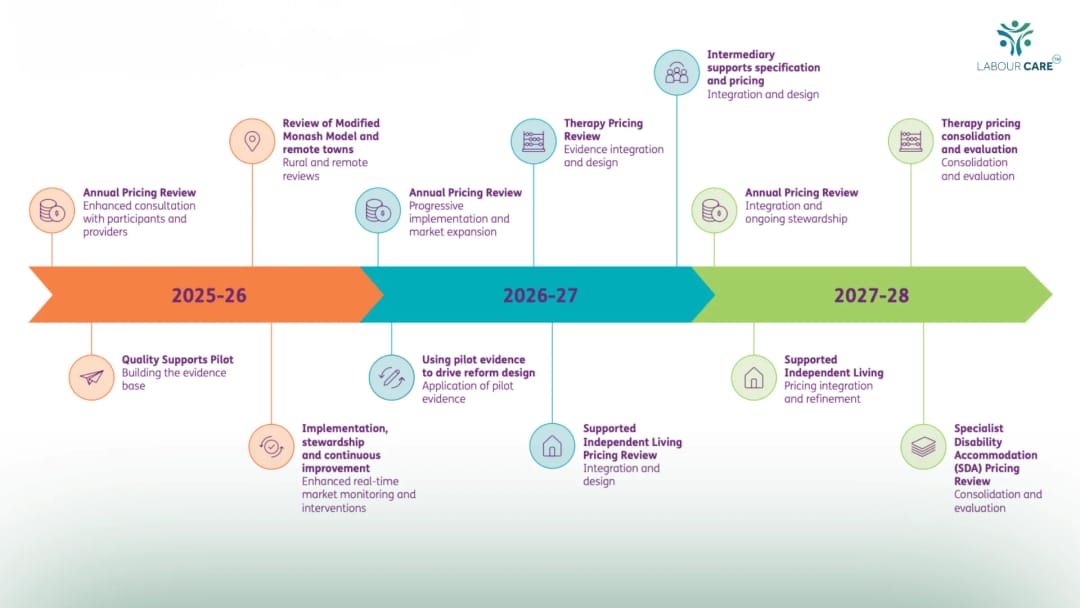
The workplan is split into three phases:
- Year 1 (2025-26): Immediate action and evidence building
- Year 2 (2026-27): Evidence-informed design and targeted implementation
- Year 3 (2027-28): Implementation and refinement
A simple way to interpret this is:
- Year 1 is about building the foundations and filling evidence gaps
- Year 2 is about designing and testing pricing approaches using that evidence
- Year 3 is about implementing outcomes and refining based on early impacts
Consultation is part of the approach
The NDIA states the workplan demonstrates a commitment to transparent consultation processes.
So while the workplan outlines intended reviews and timeframes, it also signals that provider feedback and market evidence are part of how those reviews are expected to be shaped.
Year 1 (2025-26): Immediate Action and Evidence Building
The NDIA explains that Year 1 actions develop the foundations for future pricing design, with a focus on evidence building such as quality support pilots, targeted market analysis and the 2025-26 Annual Pricing Review.
Year 1 includes four actions.
Action 1: Annual Pricing Review (core mechanism of stewardship)
The Annual Pricing Review remains the NDIA’s core annual mechanism for market stewardship and pricing decisions.
For providers, the practical implication is that the Annual Pricing Review continues to be the main annual moment where pricing settings may be updated, with workplan evidence feeding into future decisions.
Action 2: Quality supports pilots (building the evidence base)
The NDIA describes quality supports pilots as part of Year 1 evidence building to inform future pricing design.
From a provider perspective, pilots matter because they may influence how the NDIA understands costs, service delivery models, workforce inputs and quality outcomes when making future pricing decisions.
Action 3: Review of Modified Monash Model and remote towns (rural and remote reviews)
The workplan includes a review of the application of the Modified Monash Model and remote towns settings.
This signals continued attention on rural and remote market challenges, where workforce availability, travel and service continuity can be harder to sustain.
Action 4: Implementation, stewardship and continuous improvement (real-time monitoring)
The NDIA describes a focus on implementation stewardship and continuous improvement, including enhanced real-time market monitoring and interventions.
This is relevant for providers because it suggests more active market monitoring, which can affect how the NDIA identifies emerging pressures and responds over time.
Year 2 (2026-27): Evidence-Informed Design and Targeted Implementation
The NDIA describes Year 2 as the phase where pricing approaches are designed and tested, guided by terms of reference informed by the 2025-26 Annual Pricing Review, pilot insights, data and targeted consultation.
Year 2 includes five actions.
Action 1: Annual Pricing Review (progressive implementation and market expansion)
Year 2 continues the Annual Pricing Review, with the NDIA describing progressive implementation and market expansion.
For providers, this reinforces that the Annual Pricing Review remains the central cycle, while additional reforms may be progressively introduced.
Action 2: Using pilot evidence to drive reform design
The workplan includes using pilot evidence to drive reform design.
This indicates that the outputs of Year 1 pilots are intended to feed directly into how new pricing approaches are built and refined.
Action 3: Therapy pricing review (evidence integration and design)
The workplan includes a therapy pricing review, with a focus on evidence integration and design.
Therapy providers should treat this as an early signal to ensure internal cost evidence, workforce inputs and service delivery models are documented clearly, ready for consultation activity when it opens.
Action 4: Supported Independent Living pricing review (integration and design)
The workplan includes a Supported Independent Living pricing review, described as integration and design in Year 2.
SIL providers should expect this to be a structured review process informed by evidence and consultation, not a quick pricing adjustment.
Action 5: Intermediary supports (specifications and pricing)
The workplan includes intermediary supports specifications and pricing as a Year 2 action.
This is particularly relevant for providers in intermediary roles, because the workplan signals specification work as well as pricing considerations.
Year 3 (2027-28): Implementation and Refinement
The NDIA describes Year 3 as focused on implementation and consolidation, embedding outcomes of major reviews, monitoring early impacts, and preparing future stewardship cycles.
Year 3 includes four actions.
Action 1: Annual Pricing Review (integration and ongoing stewardship)
The Annual Pricing Review continues as a central mechanism, with Year 3 focused on integration and ongoing stewardship.
Action 2: Supported Independent Living and therapy pricing (integration, consolidation and evaluation)
The workplan includes SIL integration and refinement, and therapy pricing consolidation and evaluation.
This signals a shift from design into embedding changes and evaluating impacts.
Action 3: Therapy Pricing Review: Consolidation and evaluation
Action 4: Specialist Disability Accommodation pricing review (consolidation and evaluation)
The workplan includes a Specialist Disability Accommodation pricing review focused on consolidation and evaluation.
What Providers Should Do in 2026
The workplan is a roadmap, but it also signals that evidence and consultation will play a major role in future pricing decisions. Practical steps providers can take in 2026 include:
- Track Annual Pricing Review announcements and consultation opportunities as they remain the key mechanism for pricing stewardship.
- Build and maintain internal evidence that supports your pricing and sustainability story, such as workforce inputs, service delivery costs, regional constraints and quality measures.
If you operate in therapy, SIL, SDA or intermediary supports, note these are explicitly included in the workplan’s staged reviews across the 2025-28 period.
If you want to strengthen the foundations that support pricing consultations and audit readiness, Labour Care has provider-focused resources you can use internally for training and governance refreshers.
Conclusion
The NDIA’s three-year pricing workplan is designed to provide clearer direction on how pricing decisions will be informed from 2025 through 2028, using staged evidence building, structured reviews and implementation readiness across three years.
For providers, the main benefit is clarity: knowing which areas are being reviewed, when evidence will be gathered, and how pricing reforms are expected to move from pilots into design and then implementation.
If you want support strengthening documentation, compliance readiness or internal training so you can engage confidently with sector changes, Labour Care can help. Book a free consultation today.
FAQs about NDIS 3-Year Pricing Workplan:
1. When was the NDIS 3-Year Pricing Workplan released?
The NDIA released the three-year pricing workplan on 12 December 2025. It was published to give providers, participants and the broader sector clearer visibility of the NDIA’s pricing approach through 2025-2028.
2. Why did the NDIA create a 3-year pricing workplan?
The workplan was committed to in the 2024-25 Annual Pricing Review after recommendations linked to the Independent Pricing Committee’s final report. The NDIA says the roadmap is intended to support more structured pricing reform, targeted reviews and earlier planning across the sector.
3. Does the 3-year pricing workplan replace the Annual Pricing Review?
No. The Annual Pricing Review remains a central part of the NDIA’s pricing process. The workplan sits alongside it and is designed to guide staged reforms, evidence gathering and implementation over multiple years.
Share this article: